Saturday, 29 June 2013

Ecological Nirvana

Now that's what I call a field trip.

After a woeful excuse of a field trip to Scarborough that involved sitting indoors in a lab for the majority of the week this week away has finally put field trips back into the good books.

We went to Malham Tarn and stayed at the field centre there (once used by Darwin himself) which is situated by the side of the Tarn (a big lake) and surrounded by an island of mixed woodland in the middle of open hills and limestone cliffs. The walk up to the field centre from the village of Malham set the tone for the whole week by providing incredible wildlife and stunning scenery. The pair of Peregrines that nest on Malham Cove were both seen and whilst we could hear the chicks begging for food, finding them on the cliff face was impossible. A male Redstart showed up to steal the show whilst waiting for the Peregrines to make their appearance, followed by multiple sightings of Wheatear on fields above the Cove.

The field centre itself is a beautiful old building crawling with nature with Pipistrelle bats roosting under the eves, Jackdaws nesting in the masonry and a Spotted Flycatcher feeding on the lawn in front of the house. We hadn't just gone up there to admire the wildlife however. This was a module for my degree and we were being assessed on how we carried out a project. Me and another fella were mapping out and comparing the territories of Willow Warblers in two different habitats, those being the woodland and the fen. The fen was a located at the western edge of the woodland and bordered the Tarn and held some absolute treasures.

The evening that we arrived we were told to explore the area to get a feel for the place before we began our study the following day. The first thing that was noticed was the cacophony of Willow Warbler song. It felt like you were drowning in the cascading liquid song of these marvelous little birds. I feel now would be a right time to declare my love for the Willow Warbler (although I may have already done this before). To me its not the first Swallow or Chiffchaff that tells me that spring is here, but that beautiful flowing song of the Willow Warbler which never fails to put a smile on my face the first time I hear it. Although saying that, by the end of the week I'd spent so long listening to Willow Warblers that I was beginning to hear them when going to sleep at night. Which was worrying.

Top left; Sundew. Bottom left; Bog Bean. Right; Globeflower.
Down in the fen was a family of Redstarts that were one of the two we got to know quite well over the week, as well as an astonishing amount of plant life. There were Sundews (a carnivorous plant that catches its prey using a sticky secretion on its surface that form in drops), Globeflowers (which are specially evolved so they never actually open but are specially pollinated by one fly which is small enough to squeeze through the petals) and an absolute sea of Bog Bean (which I was told by my tutor is very rare and that he'd never seen anything like this).

Our work mapping the Willow Warbler territories involved doing three walks through the woodland and fen per day for 5 days. These were to be done at 6am, 1pm and 7pm. The obvious downside of this was the alarm going off at half 5 in morning but the upshot was the amount of wildlife we saw by walking through the habitats so often. We saw countless sightings of Roe Deer in the mornings and evenings, including at least two different stags and a female with two kids (Yes, Roe Deer youngsters are called kids apparently). We saw countless Spotted Flycatchers, saw a male Pied Flycatcher using a nest box and found the drumming post of a Great Spotted Woodpecker. About the only thing we didn't see were the mythical otters that were rumored to be living on the Tarn... A tantalizing footprint was as far as we got, despite the nights spent in the hide.

As spring was late it meant that breeding was still in full flow when it came to the bird life. As Willow Warblers generally make their nests in the centre of their territories then locating one would therefore represent the holy grail when it came to mapping our territories. Challenge accepted. I knew they nested on the ground and were well hidden after seeing them on Springwatch a few times. I'd never found a Willow Warbler nest before but it only took one day before I located the first one on the fen after watching the adults going in to feed. On closer inspection, the chicks were quite old so when it came to taking a picture I didn't get too close so they didn't "explode" from the nest (premature fledging to disperse themselves as an anti-predator defense).
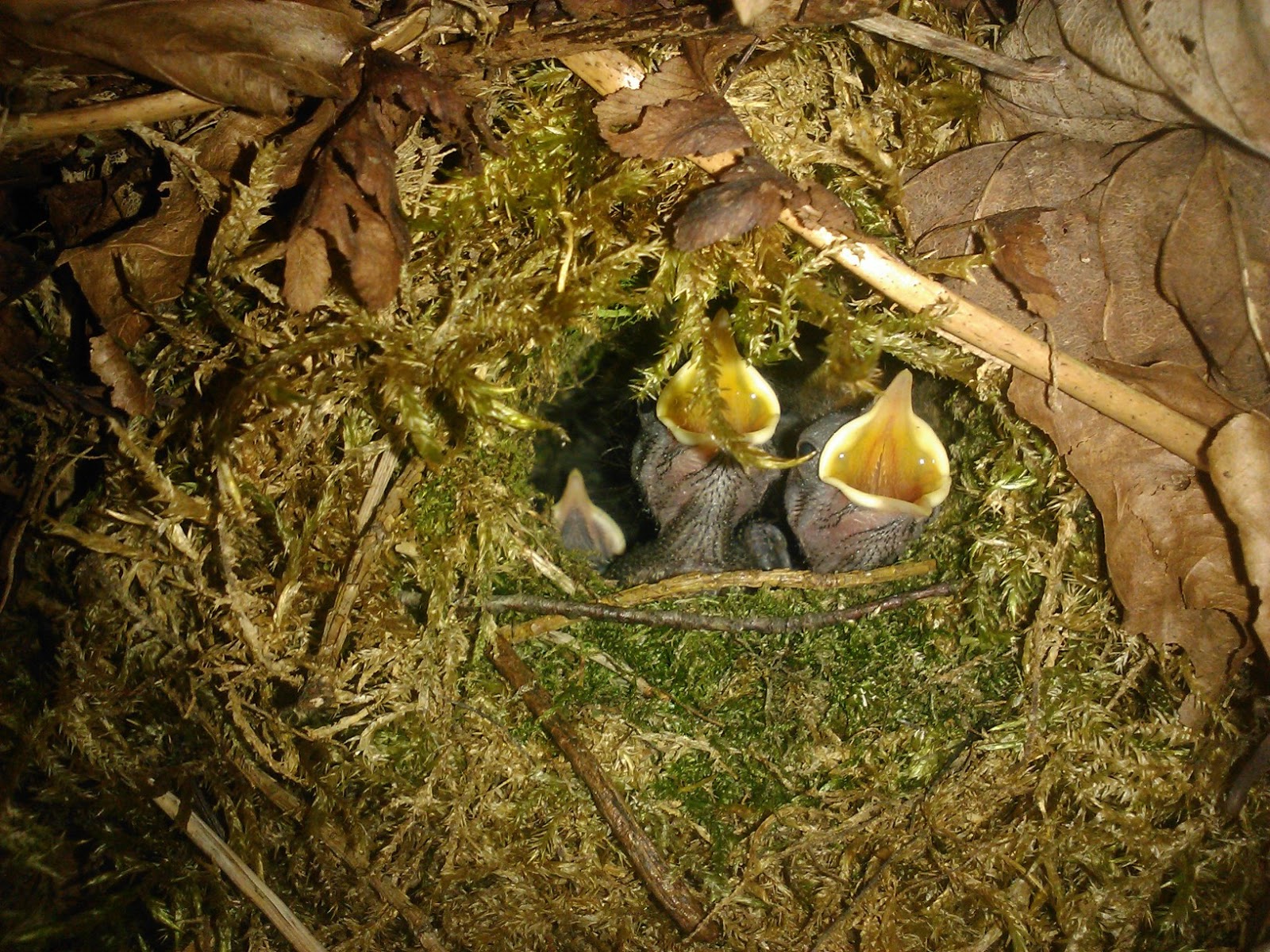
Wren chicks smiling for the camera...

The next nest found wasn't a Willow Warblers but a Wrens and was on a rock face that I was sure there would be one. Honestly you couldn't have designed a more perfect Wren nesting site than the rock face that they were using. Being a classic Wren however, the nest was impossible to find and was only given away when she flew out as we walked by one afternoon. After a quick picture we left and watched her return to the nest (always the best part of nest finding, and something I make sure to do on all the nests I find).

Tiny Willow Warbler chicks under the rock
We were then back on Willow Warbler nest finding duty and encountered one of the most incredibly well hidden nests I have ever seen. To put it into context, four twenty year old University students couldn't find the nest even after watching the adults drop to the ground with food on multiple occasions. We searched the immediate area in which the adult had landed, including under a huge rock that we felt sure the nest would be hidden under. After giving up for the day it wasn't till the next day that I decided to have another crack and watched the adult return again. This time I positioned myself at a different angle and saw it land on the floor and jump about half a metre to the rock. Once it had flew away I went to inspect under the rock more thoroughly and sure enough, tucked deep under the rock was a beautifully well hidden nest that we had missed the day earlier. What made it more remarkable was that this rock was walked on nearly everyday by people that had laid out small mammal traps in the woods yet the birds didn't seem to mind.
Willow Warbler eggs

The nest tally rose by three more after that with the finding of a nest of blackbird eggs and two more Willow Warbler nests, one with about ready to fledge chicks and one with eggs. There's just something about nest finding that never ceases to make it fun.

The project went perfectly and we presented it to the rest of the class with no problems. There was a bird ringer present (a lovely guy by the name of Chris Wright) who rang a few birds over the week, most notably Spotted Flycatcher and Redstart. I ventured over to the other side of the flying world to catch some bats one night (although I was more happy with seeing Little Owl and Curlew on the drive to the roost) and I've now borrowed a bat detector from the University for the summer to try and find out a bit more about them. Moths are also another animal high on my agenda of new things to learn about after trying to identify some that had been caught in moth traps overnight. Their colours, shapes and imaginative names sold me on them immediately and I'm keen to learn more.

But apart from that, that's about it really.


Either a Pipistrelle or Daubenton's... I'm going Daubenton's
Spotted Flycatcher being ringed


Monday, 17 June 2013

It's been too long...

Far too long.

The whole month of May has passed since I last updated my blog and whilst I'd like to tell you its because I've been enjoying the late spring to the max.... It's not. Instead I've been sat inside my room writing coursework and revising for exams for the entire month. Unfortunately the blog took the brunt of the my sacrifice.
But I'm back and about to deliver a trilogy of ornithological updates.

University is over for another year (apart from which I've just come back from) and after coming home I've instantly gone about satisfying my nature cravings starting off with a morning of ringing.

Home of the Cave Dweller...
We were trying at a new site two weeks ago but a place I know well from visiting many times. We were at Creswell Crags, a site renowned for its archaeological significance for Ice Age man. The various caves around the lake and visitor centre were once inhabited by lions, hyenas and Ice Age man and boasts the worlds most northerly evidence of cave art.
Nowadays its a great place for wildlife. Jackdaws and Kestrels nest in the cliff faces whilst a Mute Swan usually nests on the lake. Its a top place, one that I've posted about before in my "Snow Joke" post, and it made a perfect back drop for a spot of Sunday morning ringing... Especially when the centre only opens at 7 so it meant a lay in!

We caught about 15 birds including Great Tits, Blue Tits, Robin's a couple of Marsh Tit's and a nice female Nuthatch. We finally managed to add a "net over a river" to our arsenal of ringing locations and hope in the winter that we might be lucky enough to catch a Kingfisher.
Wren's nest
We were ringing in front of 3 caves that once were the home to hyena packs, evidenced by the bones found within. However in recent years its been home to a family of creatures a lot less ferocious than a pack of hyenas... Wrens.This year was no different and it didn't take long before a Wren burst from the cave and I soon located it's nest. The Wren's latin name is Troglodytes troglodytes, meaning; "cave dweller", and it's nice to see it living up to its name!

This nest was coincidentally found just minutes after I'd been talking to Dean (another trainee and a top guy) about signing up to be a nest recorder for the BTO. He's been one for a couple of years whilst Eleanor (my trainer) records all the nest boxes in the local wood and I'll soon be joining in after having sent off for a registration form the same day.

Speaking of nests... after a quiet, but still rather successful, morning basking in the glorious weather at the Crags, we decided to head over to the wood to ring a couple of nest boxes. They're all a lot later this year due to the spring but the hope is they'll still be successful with a run of good weather. Conditions last year meant that not many young were hatched successful and added to that was the senseless destruction of nest boxes containing eggs and chicks by people coming into the wood. Luckily there has so far been no repeat and early signs are good. On the way to the first nest box we stopped by one that had been partly chewed by a squirrel earlier in the year and so had one corner opened up. In the box was a nest made earlier in the year that contained two eggs that none of us were able to identify. If anyone has any ideas then I'd love to know!
6 eggs!

8 Nuthatch chicks!
After that eggcellant mystery (don't pretend like you haven't missed my high brow puns), we moved onto a nest box that had been used by a female Nuthatch for a few years and always had a big brood. However even we were surprised when we opened the top of the box to reveal 8 baby Nuthatches! Ringing these were my first pulli (baby birds) of the year and it was nice to get back into the swing of things. On the way out of the wood we stopped off to check out a Blackbird nest we'd been told about that was about a foot off the floor and contained 6 eggs. Sure enough after a bit of searching we found it, all 6 eggs included! It's incredibly vulnerable though and I don't hold out much hope for a successful fledging I'm afraid.

But before I get too comfy I'm off to the Yorkshire Nature Reserve Malham Tarn for a University field trip and I've got a feeling I'm in for a top week...

Thursday, 25 April 2013

A Name Change, Some Flamingos and a Field of Death

Not much has really happened for me to write about this week, and on top of me being snowed under with work this blog will be quite short.

First things first, a bit of house keeping.

The name of the blog has changed (as you may have noticed). I can only live under the moniker of "The Teenage Twitcher" for so long and seen as though I'm 20, it's time to put that name to bed.

From now on it'll be known by the name of the web link; "Close Encounters of the Bird Kind."

So lets start off this new dawn with a taste of the exotic. Except with it actually being in Yorkshire...

I was back at Harewood, which was being held tightly in the embrace of Spring, to help out with anything in the bird garden. It mainly consisted of feeding and watering (not literally) different birds whilst watching the Kites wheeling around. A perfect way to spend a beautiful Saturday, although the Egyptian Geese parents guarding their young in the Flamingo enclosure had me worried for my safety on more that one occasion.

I've also been on a field trip to the University's farm (where they conduct research into agricultural stuff... which you probably guessed) where we were collecting insect samples to analyse in the lab. One particular field came complete with a dead Hare, Roe Deer, Field Vole and Woodpigeon... Needless to say we didn't stay long, particularly with the ominous Buzzards circling above.


Sorry it's a bit short... To make it up, here's a picture of some Chilean Flamingos at Harewood that I took when I wasn't watching my back for any incoming Egyptian Geese.


Tuesday, 16 April 2013

Taking on the Big Guns

So last Sunday was the day I came back up to Leeds for my final term of my second University year and while I'd been visiting Clumber Park a few times to volunteer, I hadn't actually had a birdwatching session there the whole month I was back.

And that was bad news.

Let me explain. Clumber Park is my nearest National Trust property about 20 minutes drive away from where I live. I've been going there since I can remember and have spent many a day wandering through the grasses and woodlands or staring out at the lake looking for birds and altogether having a brilliant time there. I've been a member of the Clumber Park bird group since I was ten and we go on organised walks around Clumber or further a field which I go to whenever I can.

Now the Clumber bird group is headed by a formidable pair of birders that lead the walks and on top of being brilliant birders there also top blokes. Anyway, at the start of every year everyone in the bird group gets sent a list of birds you have a chance of seeing in Clumber Park with the newsletter with the idea of keeping a Clumber list throughout the year and eventually comparing at the end. And like any good bird list, there's always a little bit of competition bubbling away under the surface.

Yet this is only the first year I've ever had a go. That's because the birding giants of the group are at their weakest they've been for a long time. And now I'm going for the jugular.

When I joined the group there were originally 4 imperious birders that would lead the walks. This has since been halved over the past years and now of the 2 left, only one of them regularly birds in Clumber. So this is my chance. If I can make use of my time at home and maximise my bird sightings, I may have a chance of claiming number 1 spot. Or second spot. Yeah probably second spot.

But it hadn't got off to a great start as I'd only been once in this current year back in January. Although I did get 37 birds, I was still way behind the competition. So when I saw there was a walk with the Clumber Bird group I had to make sure I was there to try and pull myself closer! Plus birding with experienced birders is always a brilliant way of seeing things you'd never see yourself and learning loads in the process.

The walk got off to a flying start with the years first Swallow singing from the farm buildings at the car park as we arrived. It was then marred slightly by my inability to find a Sand Martin that was flying over the lake when all the other people looking could see it (yes it was one of those moments!) but that was soon all behind me when I spotted my first Chiffchaff of the year in the park. Lapwing were a good spot whilst a drumming FEMALE Great Spotted Woodpecker caused much interest in the group. It seems it isn't only the males that are at it as some books would have you believe!

However the bird of the day was one we didn't see but heard, and its one of my all time favourites. Many people associate Chiffchaffs or Swallows as the start of Spring, but for me nothing beats the cascading song of the Willow Warbler to tell me that Spring is steam rolling in. It's a song that conjures up lazy hot days and one of my top tunes on my soundtrack to Summer. I thought with the incredibly cold weather that we'd been having that these little gems wouldn't have returned by now, or if they had they certainly wouldn't be singing. But I was very glad to be wrong. Now I like to see birds before I tick them off on a personal list but the rules of the Clumber list allows hearing to be enough for a tick. So that meant Willow Warbler went down for the year. And for one of my favourite birds I was more than happy to make an exception.

Bird List for the Day:
 
Swallow
Mistle Thrush
Pied Wagtail
Carrion Crow
Blackbird
Buzzard
Collard Dove
Chaffinch
House Sparrow
Woodpigeon
Mallard
Tufted Duck
Coot
Mute Swan
Greylag Goose
Lapwing
Magpie
Reed Bunting
Great Crested Grebe
Great Tit
Chiffchaff
Goldcrest
Blue Tit
Shelduck
Great Spotted Woodpecker
Jackdaw
Wren
Moorhen
Canada Goose
Cormarant
Gadwall
Robin
Kestrel
Yellowhammer
Starling
Goldfinch
Skylark
Stock Dove
Dunnock
Pochard
Pheasant
Black Headed Gull

Heard: Willow Warbler